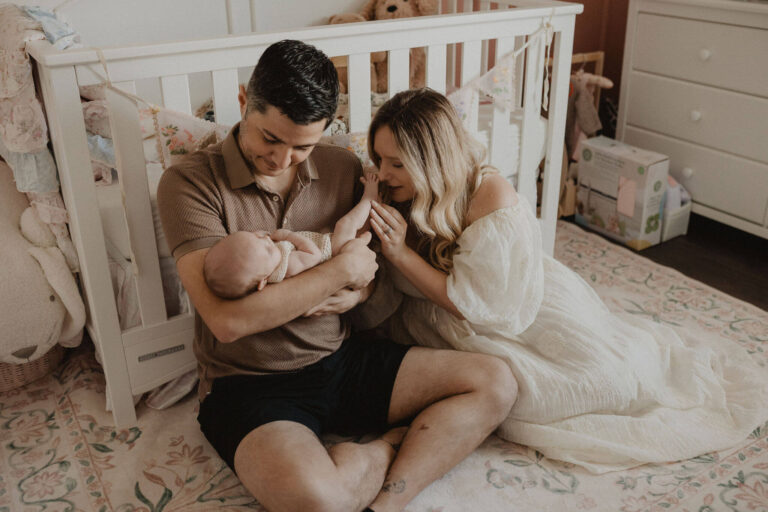
Welcome back to my July blog series featuring sleep professionals who support families through every stage of childhood. If you’re searching for a virtual sleep consultant who can provide personalized guidance from the comfort of your own home, today’s interview is one you won’t want to miss.
I am excited to introduce Liz Harden of Little Dipper Wellness. As a certified virtual sleep consultant, Liz helps families navigate everything from newborn sleep foundations to bedtime struggles in older children and teens. In this interview, she shares practical advice, common sleep myths, and her compassionate approach to helping families find solutions that fit their values, parenting style, and unique circumstances.
Table of Contents
Interview with Little Dipper Wellness – Virtual Sleep Consultant
Hey, Liz! Please tell us about your business.
Hi! I’m Liz Harden, founder of Little Dipper Sleep (part of Little Dipper Wellness LLC). I’m a certified sleep consultant with a master’s in public health, and I do two things: I work directly with families to help their children sleep better, and I train healthcare providers, educators, and family-centered professionals to confidently integrate evidence-based sleep guidance into their own practice. I’m also a certified mindfulness instructor, and I weave mindset work into everything I do, because an overwhelmed parent can’t implement even the best sleep plan.
On the family side, I specialize in complex cases where standard approaches haven’t worked, and I meet every family where they are in terms of values, comfort level, and capacity. All of my work is done virtually, which means I serve families and providers across the country.
What are the most common sleep challenges families come to you with?
The big ones: babies and toddlers who need a parent present (feeding, rocking, or patting) to fall asleep and then wake up throughout the night needing that same support. Early morning wakings. Nap resistance. Split nights. Bedtime battles that drag on for an hour+. I also work with a lot of preschoolers and older children with bedtime resistance and night wakings, since there are very few sleep consultants who specialize in those ages. And across all of it, I see parents who feel like they’ve tried everything and are convinced something is wrong with their child (or themselves). Nothing is wrong. Sleep is a skill, and most families just need a plan that actually fits them.


What is one piece of sleep advice you wish every expecting parent knew before their baby arrives?
Your baby’s ability to settle and sleep is deeply connected to your own state. Babies co-regulate, meaning they take cues from your nervous system. When you’re tense and depleted, your baby feels that. When you’re calm and grounded, they feel that too. This doesn’t mean you need to be perfectly zen at 3am (no one is), but it does mean that taking care of yourself and reducing your own stress is not separate from helping your baby sleep. It’s part of it. I wish more parents knew this before the exhaustion set in, because it reframes the whole experience.
At what age should parents consider working with a sleep consultant?
Any age. I work with newborns all the way through school-age children. There’s no age too young to start building healthy sleep foundations, and no age too old to make meaningful changes.
What are some common myths about infant and toddler sleep that you would like to debunk?
A few of my favorites to tackle:
Myth: If you feed your newborn to sleep, you’ll create a habit they can never break. Feeding to sleep is one of the most natural things a parent can do in the early weeks, and it works beautifully at that stage. When the time is developmentally right (usually somewhere around 5 to 6 months), families who want to shift away from it can do so gradually and gently.
Myth: Sleep training means letting your baby cry it out. There are many approaches to building healthy sleep skills, and “cry it out” is just one of them. I use flexible, evidence-based methods that match each family’s comfort level.
Myth: A later bedtime means a later wake-up. In many cases, the opposite is true. Overtired babies often wake earlier and sleep worse.
Myth: You’ve “ruined” your child’s sleep by doing what you needed to survive. You haven’t. Sleep skills can be learned at any stage.
What does a typical consultation look like, and what kind of support do families receive during the process?
We start with a detailed intake form so I understand the full picture before we ever meet. Then we have a one-on-one coaching session where we build a personalized plan together. Every family gets a custom Stellar Sleep Guide with their schedule, strategies, and step-by-step guidance tailored to their child and their parenting style. Depending on the package, families can also access ongoing coaching sessions and email or text support as they implement.


Do you work with newborns, infants, toddlers, or children of all ages?
All of the above. I work with newborns through teens (and even parents, too!). Each stage of sleep development is different, and I love working across the full range.
What services do you offer? What is the typical investment for families who work with you, and do you offer virtual consultations?
Yes, all of my work is done virtually, which means I can serve families anywhere. Here’s a quick look at my current offerings:
Stellar Sleep Guide ($175): A comprehensive, personalized sleep plan without the ongoing coaching commitment. Great for families who just need a solid plan to run with.
Single Coaching Session ($150): A focused, one-time call. Can be bundled with the Stellar Sleep Guide for $245.
North Star Package ($395): A custom sleep plan plus up to five coaching sessions. Families can also add ongoing email or text support if they want a direct line throughout the process.
How long does it typically take families to see improvements in their child’s sleep?
Faster than most people expect. When families start with good foundations (schedule, environment, routine, mindset), many see early improvements within a week. Once we move into active sleep skill-building, the first few nights are usually the hardest, and then things tend to improve quickly from there. Meaningful, lasting change usually happens within a few weeks.
Is there anything else you would like expecting or new parents to know about healthy sleep habits?
You don’t have to choose between being a responsive, loving parent and having a child who sleeps well. Those two things are not in conflict. The families I work with are some of the most thoughtful, attachment-minded parents out there, and they get great sleep results. And the parent’s experience matters just as much as the child’s. When you feel calmer and more grounded, everything shifts, and that’s always part of the work we do together. Give yourself grace in the early months, build your foundations early when you can, and know that help is available whenever you’re ready for it.


Virtual Sleep Consultant for Babies, Kids, and Parents
Little Dipper Wellness LLC
Website – littledipperwellness.com
Instagram – @littledippersleep
Bluesky – @littledippersleep.bsky.social
Facebook – @littledippersleep
LinkedIn: https://www.linkedin.com/in/liz-harden-zzz/
Best way to contact: liz@littledipperwellness.com
Victoria Vasilyeva Photography offers in-home newborn and family photography sessions in Raleigh, Fayetteville, and Greensboro, capturing authentic moments for growing families throughout North Carolina.
Q&A with Honeysuckle Lactation Consultants – Breastfeeding Support for Raleigh Familiesv
Chapel Hill Family Photographer – Victoria Vasilyeva Photography
Raleigh Fertility Clinic Guide: 4 Top Options for Parents Growing Their Families